
The Crime of Holding Your Government Accountable

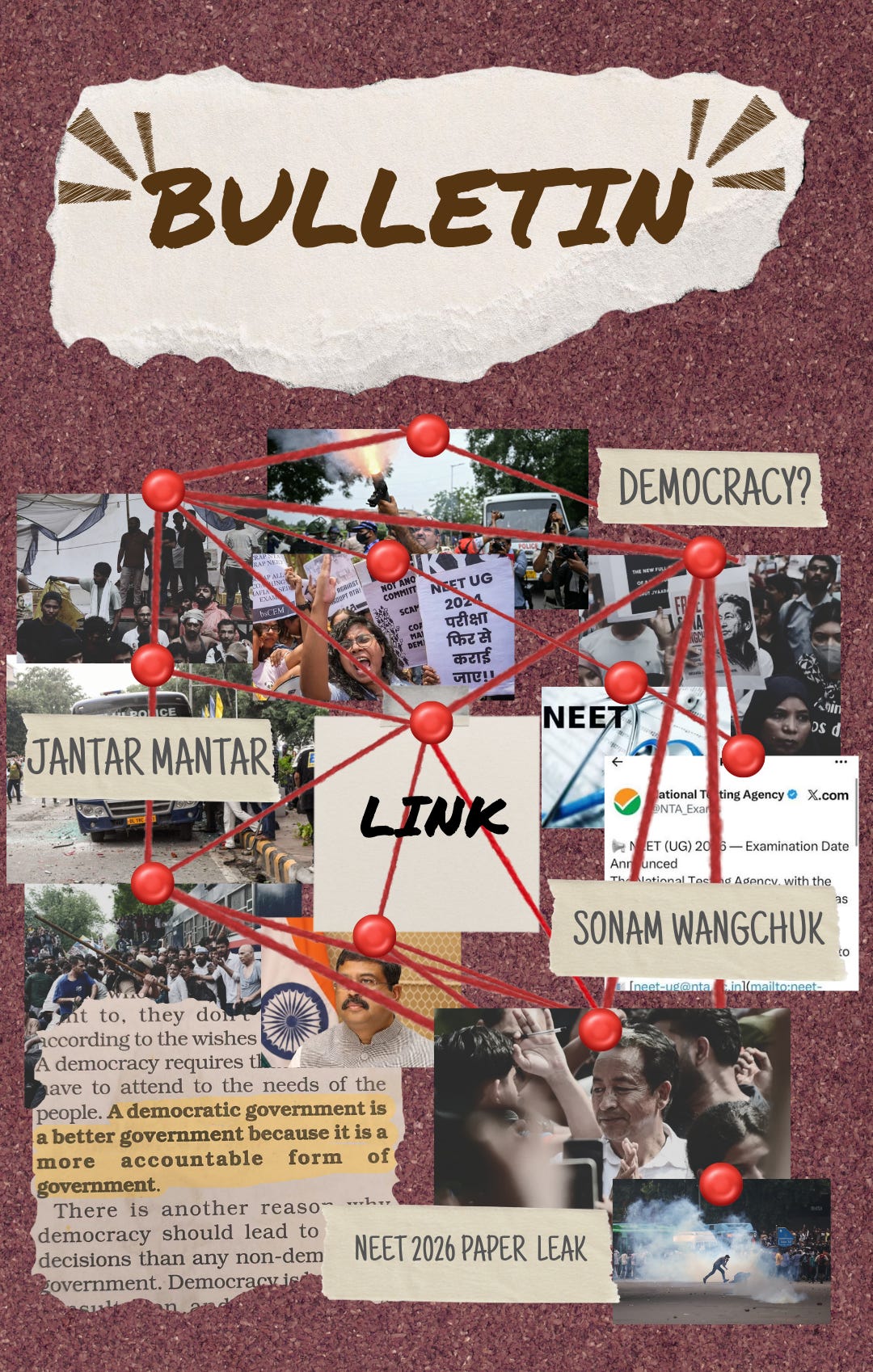
A democratic government is a better government because it is a more accountable form of government.
Chapter 1, Class 9 NCERT Textbook
Ahimsa, an idea popularised by Mahatma Gandhi, always sought to fight sociopolitical issues through non-violent and peaceful protests. It was a movement that proved that ordinary citizens, armed with nothing but conviction, could challenge those in power. This legacy did not die with India’s independence. It continues to live on in democratic spaces such as Jantar Mantar, which for generations has been a designated site to hold such protests. Over the decades, citizens from all over the nation have gathered here to make their voices heard. However, recent events suggest that it is easier to silence these voices than to acknowledge them. In the early hours of 18th July, Sonam Wangchuk was forcibly removed during his hunger strike. Many protesters participating in the “Chalo Sansad” march were also detained. This pattern is hard to ignore. Peaceful demonstrations have repeatedly been met with barricades instead of answers.
One of the major demands of the protesters is the immediate resignation of the Education Minister, Dharmendra Pradhan. This demand stems from the numerous alleged paper leaks of examinations that determine the future of millions of students. Thousands have gathered on the streets of Delhi, calling for major reforms in the education system. Unfortunately, the movement has been met with police brutality and task forces being deployed to disperse the composed crowd.
No matter how peaceful the protest, the government’s response so far has been one of weapons rather than dialogue. On 20th July, semi-automatic rifles were pointed at protesters as a lathi charge swept through the crowd, assaulting men and women, old and young, without hesitation. Canisters of tear gas were hurled, and blood was spilt, all against a movement meant to bring attention to a series of events that have ruined lives.
The role of the media in movements like these is just as important as the protests themselves. Yet, in the past few weeks, many of the biggest media houses couldn’t spare a single headline for the aggrieved students demanding answers. Often described as the fourth pillar of democracy, the press exists to inform the public and question those in power. But when it is sold to power-hungry institutions, journalism becomes propaganda and starts protecting those at the top. By distorting the truth and isolating legitimate movements, the media becomes another barricade standing between the people and justice.
A country that takes pride in being the world’s largest democracy has denied its people the fundamental right to a peaceful protest. A political system that boasts about its freedom of expression has turned against its very own people. These incidents are a reflection of a larger pattern that has been unfolding for years. Any credible criticism made against the government or its policies gets labelled as an anti-national sentiment, while those in power escape the very accountability democracy demands.
Every cry for help against this failing system is met with cold indifference. What is to become of this nation, if it chooses to ignore the multiple suicides of its students amid its own failures? A democracy cannot afford to treat its young citizens as bothersome pests. When institutions stop answering questions, public trust begins to crumble. For the powerless, a protest is more than a gathering on the streets, it is a lifeline to those in power. And when that’s taken away, all that remains is silence.
The danger extends far beyond exam halls or police barricades. It lies in normalising the belief that accountability is optional and resistance is futile. As cracks begin to form in the foundations of democracy, we may soon find ourselves living in a land where the strings of our destiny are tied to the hands of our oppressors. If the choices of Sonam Wangchuk, a man who has been indispensable to thousands of people, are not being respected, what hope remains for the youth who are currently bleeding on the streets of Delhi?
In the past, protests shaped history, leaving their mark in textbooks as defining moments in our country’s liberation. Today, everything has been reduced to a social media trend, with public outrage fading long before meaningful change arrives. We came from a generation of Indians who fought to achieve this democracy, and we must be the generation to take it back. The future does not arrive all at once. It is built, piece by piece, through decisions that are made in the present. Every silenced protest, every unanswered question, and every failure left unaccounted for becomes another brick in the downfall of democracy.
Lnd editoriallllllllll
I love this